Monday, 24 February 2014

Review: Marathi film Time Pass is worth your time


Ravi Jadhav’s debut feature film Natrang, was a critical and commercial success. He followed it up with a period biopic Balgandharva which was grand, but left a lot to be desired. Last year, he kick-started the year for Marathi cinema with a fabulous film called Balak Palak (BP). And now, he kick-starts 2014 with a cinematic ode to the tender concept of first love – the kind that happens irrespective of education, family, socio-economic status which are the endless parameters that define the framework of love and relationships as we grow older.
Dagdu (Prathamesh Parab) is a rickshaw driver’s son, who has successfully flunked his SSC exams, and has been kicked out. As he delivers newspapers to make some money, Dagdu meets his Jaani Dushman – aka Lele. With qualifications and designations pasted on his door, Lele is your typical lower middle-class Marathi man who prides on his education, hatred for cinema and living life like a total robot.
Enter Dagdu’s friends who convince him that he needs some "TP in life" before giving him a short yet hilarious discourse on the varied types of love. That’s when Dagdu notices Prajakta (Ketaki Mategaonkar) in addition to being his arch nemesis’ daughter, she is also what they collectively consider MM (marriage material).
Dagdu does very 80s Bollywood love-storyish things like following her, singing in the rain and then jamaoing impression before her with filmy monologues etc. Love blooms between the two as Dagdu helps the repressed Praju (whose name he cannot even pronounce) find herself through song and dance. But what happens when the two lovebirds fly into reality? What happens when love stops being just TP and consumes you completely? If you look to TP to answer those questions, you'll have to wait. The film ends with a hook, suggesting a sequel.
Ravi Jadhav proves himself a compelling story-teller as he establishes the story, and its background with a very stylized, distinctive voice. Using a stellar background score, enthralling music and some snazzy editing wisely, Ravi Jadhav pulls you into Dagdu’s world quite cleverly. Be it Dagdu’s first face-off with Lele, where Lele bursts into a hilarious Marathified Hindi lines or Prajakta enacting Dagdu’s monologue in front of the mirror or the singers breaking into Sai Baba bhajans to the tune of popular Hindi songs in the background as Dagdu seeks divine intervention – Jadhav has a distinct style of bringing out different dimensions to his story.
And the cast co-operates wonderfully with Jadhav by giving honest, realistic touches to their characters. Prathamesh's performance is a tad to over-the-top but it ends up working for Dagdu, and Ketaki’s Prajakta is largely demure with bursts of ‘jhatak’ touches.
The music of the film is rather impressive. Chinar-Mahesh turn ‘Chhan Kiti Diste Fulpakhru’ -- an innocent poem most kids learn in school into a fun riot with a touch of rock.
Time Pass's story is essentially one line and in the second half it feels a bit stretched. But barring that and a misplaced item song, Time Pass makes for an entertaining experience. Time Pass begins as time pass, and as you laugh and guffaw with it, it turns out to be an emotional ode to first love. This one’s definitely worth a watch -- Aai-Baba anni Sai-Babachi shappat!

TP-Timepass team in Singapore


Filmmaker Ravi Jadhav along with producer Nikhil Sane and actors Ketaki Mategaonkar and Prathamesh Parab received an overwhelming response in Singapore.

Two special shows of 'TP-Timepass' were organised in Singapore on special demand by the Marathi audience there. Ravi said, "I am so happy that the film is running to packed houses. It's such a great feeling to see people love the films I make. In the past as well, my films like 'Natarang', 'Balgandharva', 'Balak Palak' have been well received."

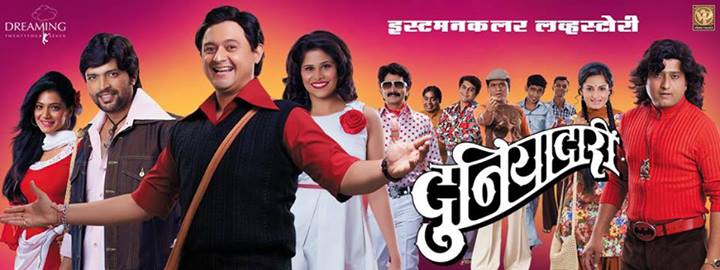
Duniyadari' breaks Marathi box-office records


Marathi multi-starrer Duniyadari, directed by Sanjay Jadhav, is about how different people eventually realise the true meaning of life — in different ways. The movie has opened to a thunderous response at the box office along with critical acclaim. It has been running to packed houses in Maharashtra, Goa, Karnataka and Gujarat. 

The film has a record 710 shows daily and more than 5,000 shows weekly across 270 theatres. Currently in its sixth week, the film is rewriting Marathi box office history. A joint venture between E-sense Motion Pictures Pvt. Ltd and Maharashtra Kalanidhi with Zee Talkies, it stars Swapnil Joshi, Ankush Chaudhary and Sai Tamhankar, among others.

Says producer Nitesh Rane, "Marathi cinema has taken an upward swing. I am proud that Duniyadari has set a new benchmark for the industry. I won't be surprised if Marathi cinema enters the 100-crore club soon. We are planning to auction the outfits that various characters have worn in the film. The money collected will be donated by Maharashtra Kalanidhi to the Uttarakhand flood victims. Ours is one of the oldest film industries in India. The idea is to work on films that are unique. We not only want to promote Marathi cinema, but also inspire people."

Why most Mumbai local train motormen are stressed and anxious

  • Prashant Chaugule DNA
It is not just the suburban commuters who are in the danger of losing their lives. The motormen piloting the 2,900-odd local trains don't find themselves in the pink of health either. A host of problems, inherent to the city, are also shooting up the blood pressure, anxiety levels of the city's motormen. dna provides a round-up of these dangers based on the talks this paper has had with several motormen, who as per rules, cannot come on record with the media.
Track crossing
The single largest killer in the suburban system with more than 50 per cent of deaths caused due to people taking their chances at hopping across a set of a tracks with a speeding train. "The moments before you realise your train is going to hit a track-crosser is plain harrowing. You can so easily feel your stomach churning, the blood pressure shooting up, the hands going cold. The sound of bones crushing, the head being punctured or seeing a dismembered body along the tracks are things that stay with you for several days," said a motorman.
Tough days
Incessant Mumbai rains, or an overhead wire snapping, or any such incident that gets the city's railway stations packed to the brim, is a nightmare for the motorman. "People standing on the edge of the platform make us feel that the sides of the train will knock of some heads. The lingering fear is that at the last moment someone will fall off the edge and come right underneath the train. It is a sickening feeling," said a motorman who regularly plies on the Hrabour line.
Public ire
Gone are the days, say motormen, when they were greeted with smiles or a handshake by travelling crowds. Today, thanks to the umpteen strikes by motormen and the chaos that descends on the city thereafter, motormen find themselves at the centre of people's ire at stations. The situation has got so bad that the Railway Protection Force has had to paste posters inside trains warning people against making motormen the subject of public anger. "Every passing day, the anger against us just gets more entrenched," said a motormen.
People on mobiles
It is getting to be the single largest concern for motormen. The broad consensus among them is that a predominant number of youngsters crossing tracks are engrossed in their mobiles and the use of hands-free etc sometimes ensures the train's warning horn goes unheard. "We see it all the time especially at stations which have colleges nearby. There have been a few incidents of people dying because their attention was diverted because of mobile phones. In the days to come, it is going to increase," said the motorman.
Stunts
The Harbour line stretch between Govandi and Masjid is the worst affected with the menace of stunts but it is slowly spreading to other lines as well, observe motormen. "Watching someone perform a stunt in a train passing next to the one you are piloting always makes you feel uneasy," said a Harbour line motormen.

Marathi film Fandry is a rich experience

It’s Valentines’ Day. We’re going for our dose of romance, painted bright fuchsia, steeped in sugar-water and sprinkled with rose-petals. But there’s a Marathi film, a love story in theaters this V-Day that’s painted rustic brown, steeped in sweat and sprinkled with dust. And I’d exchange a thousand pinky pink romances to watch a film like this.
Now, don’t think this is a review. Because it isn’t.
To put it frankly, I don’t think I have the ‘aukaat’ to critique a film like ‘Fandry’. And I won’t.
Fandry is a love story – between tradition and aspiration. Fandry is a flirtation between the modern day rural India that romances tradition and a mindset that cares to break free of it. Fandry is many things but mainly Fandry is the story of Jabya Mane – born to an untouchable family, dark-skinned and poor – who carries a torch for the comparatively rich, fair-skinned, higher caste Shalu. His father struggles to make enough money to pay dowry for Jabya's sister, while his mother convinces Jabya to help the family out in menial jobs with a promise of new clothes. Jabya spends time after school chasing a certain kind of a bird with his pal Pirya. Meanwhile, pigs running wild in the village, causing a menace to the higher castes.
Jabya’s world is very different from that of his family – divided between the life he leads in school and the one that is expected of him as a child of the untouchables. He revolts when called kalya (blackie), he refuses to remove a piglet from a well (only untouchables are allowed to touch pigs) and tries his best to hide his life from his school friends.
In the middle of all this, he finds a friend in the village drunk, also a dreamer (brilliantly played by the director himself) who shows him hope.
In Fandry, the director tells the story through the dialogue and actors but what is fascinating is that he uses objects, landscapes, animals and birds to build a thoroughly engaging film experience.
Nagraj Manjule’s voice as a filmmaker is very distinct, exciting and vibrant. Nagraj extracts measured, precise performances from seasoned actors like Kishor Kadam & from debutants like Somnath Avghade alike. The influence of world cinema on Fandry is quite obvious, and it adds a touch of global appeal to the story that is based deep in the heart of Maharashtra.
When the film ends, it only ends on the screen, igniting thoughts in your mind. The film brings you face to face with the reality of the caste system in a hard-hitting manner but there’s entertainment too.
Pain, anguish, aspiration, desire and hope form the soul of Fandry, and it will take me a few re-watches to take in the film completely. A film like Fandry comes along rarely. And when it does, it must be watched and celebrated.
Go watch right now. Fandry released on the 14th Feb in theaters across Maharashtra and has English subtitles. GO WATCH NOW.
Review in motion: